Studio — Intent-First Workflow Builder
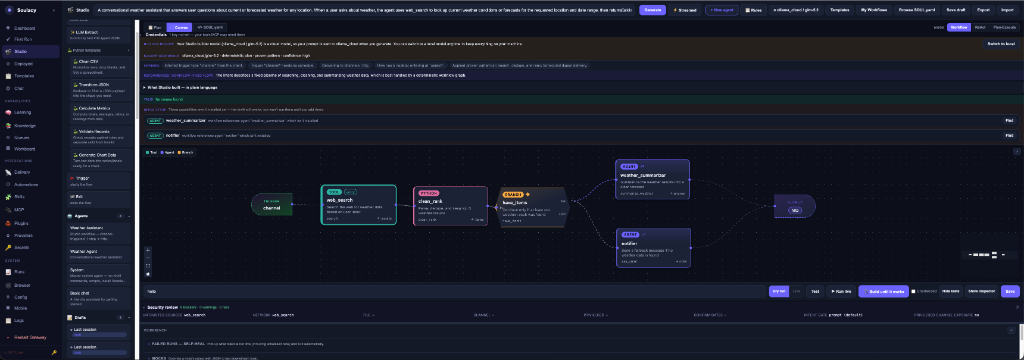
Studio turns a plain-English description of the automation you want into a runnable Soulacy workflow. You describe the outcome; Studio drafts a step plan, generates the graph, checks it end-to-end, and — when a run fails — proposes a fix you can review before saving.
You never have to start by dragging boxes on a canvas. The graph is generated from your intent, not the other way around.
The three views
Every workflow can be inspected three ways, and you can switch between them at any time:
| View | What it shows | Use it to |
|---|---|---|
| Plan | The workflow as plain-English steps, grouped into lanes | Understand and edit what happens |
| Canvas | The generated node graph | See data flow and wiring |
| SOUL.yaml | The underlying agent definition | Review or hand-edit the source of truth |
The Plan is the primary surface. Canvas and SOUL.yaml are always kept in sync with it.
Plan lanes
The Plan organizes steps into six lanes that map to how an automation actually runs:
- Trigger — what starts the workflow (a message, a schedule, a webhook).
- Gather — collecting inputs and context (fetch a URL, read the knowledge base, pull a file).
- Think — reasoning, analysis, or an LLM/agent step that decides what to do.
- Act — taking an action (call a tool, run Python, hit an API).
- Verify — checking the result is sane before anyone sees it.
- Deliver — sending the result to a channel or returning it in Chat.
Entry and exit are implicit — you won't see confusing "start"/"end" blocks to wire up. Studio adds them for you.
Building a workflow
- Open Studio and describe the automation in one or two sentences, e.g. "Every morning, summarize my unread email and post the summary to Slack."
- Studio drafts a Plan. Read it top to bottom — it should match your intent.
- Add or change steps in natural language ("also attach the original links", "only include emails from my team"). Studio recommends the right block type — a Python step, a tool call, or a sub-agent — for each addition.
- Switch to Canvas to see the generated graph, or SOUL.yaml to read the source.
- Save. Every workflow passes a whole-workflow integrity check before it can be saved — dangling references, missing variables, unroutable outputs, and invalid Python are caught here, not at runtime.
Streamed vs Wizard generation
The Generate button has a Streamed / Wizard split — Streamed (the default)
runs all five pipeline phases (clarify_intent → choose_strategy →
build_graph → validate → repair) in one shot and streams a live transcript
below the canvas so you can see each LLM I/O as it lands. Wizard mode opens
the refinement modal with a Wizard-steps breadcrumb at the top, letting
you inspect and edit intermediate output between phases. A (once) label
appears on the split-button when you're overriding the persisted default; the
default itself lives under Studio model modal → Generate presentation.
Runtime intent presets
The Studio model modal has a Runtime intent section with three named presets:
- Fast local — small local model, tight timeouts, high loop cap. Best for quick "does the shape look right?" iteration.
- Reliable local — patient timeouts sized for weaker local models, so a slow-first-token model doesn't get killed mid-turn. The default.
- Cloud quality — long total budget with generous per-step timeouts, applied even for cloud providers so long plans have room to breathe.
Selecting an intent persists to llm.studio.preset; the next Save bakes those
timeouts into any agent Definition that doesn't already override them.
Reasoning-agent contract checks
Studio's contract validator runs a full battery of checks on reasoning agents (agents authored as a system prompt + tool allowlist rather than a graph). Each check produces a blocker (Save-blocking) or warning:
agent.system_prompt— blocks an empty prompt (the prompt IS the agent spec); warns under ~40 words.agent.tool_allowlist— blocks a ReAct loop with no tools / peers / skills / knowledge bases; warns on the same for non-ReAct.agent.peer_graph— flags danglingagent__<id>mentions in the system prompt.agent.prompt_hygiene— warns when the prompt says "use `X`" for a tool that isn't in the allowlist.agent.step_budget— realism band on MaxTurns / StepTimeout / TotalTimeout / RunTimeout; blocks unbounded ReAct > 40 turns; warns whentotal_timeout < max_turns × step_timeout.agent.channel_delivery— warns whenchannel.sendis in Tools but Channels is empty.agent.llm_fit— blocks embedding models; warns on weak-JSON models, small-context + high-turn combos, and provider-not-in-allowed_providers.agent.capability_scope— warns on privileged scheduled non-Unattended agents, and on very open policies.agent.persona_consistency— flags contradictions likeMustNot+tool_choice=required, or JSON-format constraints withoutresponse_format.agent.builtin_scope— blocks opt-out-of-everything shapes; warns onkb_searchwithout Knowledge orread_skillwithout Skills.
The Save-blocking capability audit runs on top of these: any save that would escalate an agent's tier (ReadOnly → Active → Privileged) while it has interactive channel bindings pops a blocking modal listing the tier diff, warnings, and affected bindings, and requires an explicit acknowledgement before the save proceeds.
When a run fails: Debug in Studio
Any failed run in Activity has a Debug in Studio button. It loads the exact failed run trace so Studio can see what really happened:
- which node failed, and its inputs and outputs;
- any missing variables or bad tool arguments;
- channel/delivery errors.
Studio then proposes a fix in plain English ("the city variable is never
set before the Gather step — bind it from the trigger message"). Three
things happen when you click Debug in Studio:
- The failing input is pre-filled into the test bench so the fix can be verified against the exact input that broke the run — no reconstructing.
- The structured run trace loads into the runTrace panel and the run-history picker, alongside the compacted evidence blob inside the heal result — so you're not restricted to the summary.
- The heal result routes through a diff panel with Apply this fix / Cancel buttons. The canvas only changes when you confirm; the proposed diff is visible before it becomes reality.
Build until it works
If you'd rather not iterate by hand, choose Build until it works. Studio runs a bounded series of repair attempts, testing after each one, and stops as soon as the workflow succeeds (or reports clearly if it can't converge). When a repair succeeds, Studio captures the failing case as a regression test so the same break can't silently return.
The Build report has two sections above the attempt log so you can tell "needs my input" from "still trying":
- Needs your input — external blockers Studio can't fix on its own (missing credential, bot not invited, rate limit, invalid destination). The report header prefers this over a raw residual dump — "Stopped — needs your input: …" rather than "Could not fully fix it automatically".
- What Studio changed — a plain-language rollup, one bullet per changed attempt, of the edits the loop applied. Makes it obvious what actually moved between attempts.
See also
- Workflow Templates — start from a vetted workflow instead of a blank Plan.
- Evaluations — lock in behavior with
sy eval. - Troubleshooting: Common failures.